
1849
Kastor Egloff opens a small workshop in Rohrdorf, producing metal cooking utensils.
Kastor Egloff opens a small workshop in Rohrdorf, producing metal cooking utensils.
He opens a foundry and the company reaches a turnover of 150,000 Swiss francs. Wilhelm and Julius, Kastor’s oldest sons, start working with their father. During 1876 Kastor Egloff purchases a deep drawing press – the first in Switzerland – and starts producing mess tins and other tin-plated household items. After Egloff’s injury his son Julius takes over the company and in 1884 the company adopts the name Kastor Egloff & Sohn. Brothers Julius and August Egloff take the helm of the company. The number of employees rises to 55.
Later on, in 1894 brothers Adolf and Karl Reber invest 400,000 Swiss francs to acquire a shareholding in the company. The company name becomes Kastor Egloff & Cie. Hermann Weber, Karl Reber’s brother-in-law, joins the company. When Karl Reber dies in 1902, Gottfried Birchmeier starts working at the company, which he is also a shareholder of. Some years later Kastor Egloff dies at the ag of 85. Susequent, the company is sold to Merkenr & Co. and it changes its name in Metallwarenfabrik Egloff & Cie.
After the generational handover, the Niederrohrdorf factory produces the first Bircher-Raffel: an apple grater invented by doctor and nutritionist Maximilian Bircher, the father of Muesli. It proves to be one of the era’s most successful household items.
The Supra I, the first filter coffee machine produced by Metallwarenfabrik Egloff & Cie, is introduced.
The Express Junior model is introduced. It has a gas-heated, 4-litre boiler and awand for steam and hot water
The Rekord model is released on the market.
The Supra II enters production before World War Il begins.
After a complex period resulting from difficulties finding raw materials due to the global conflict, the company begins to grow again, achieving a turnover of 3.2 million Swiss francs and reaching 200 employees.
After World War II, the Swiss company creates different versions of the Express II (1947) and Supra III (1949) models.
Turnover reaches 7.2 million Swiss francs and the number of employees rises to 285.
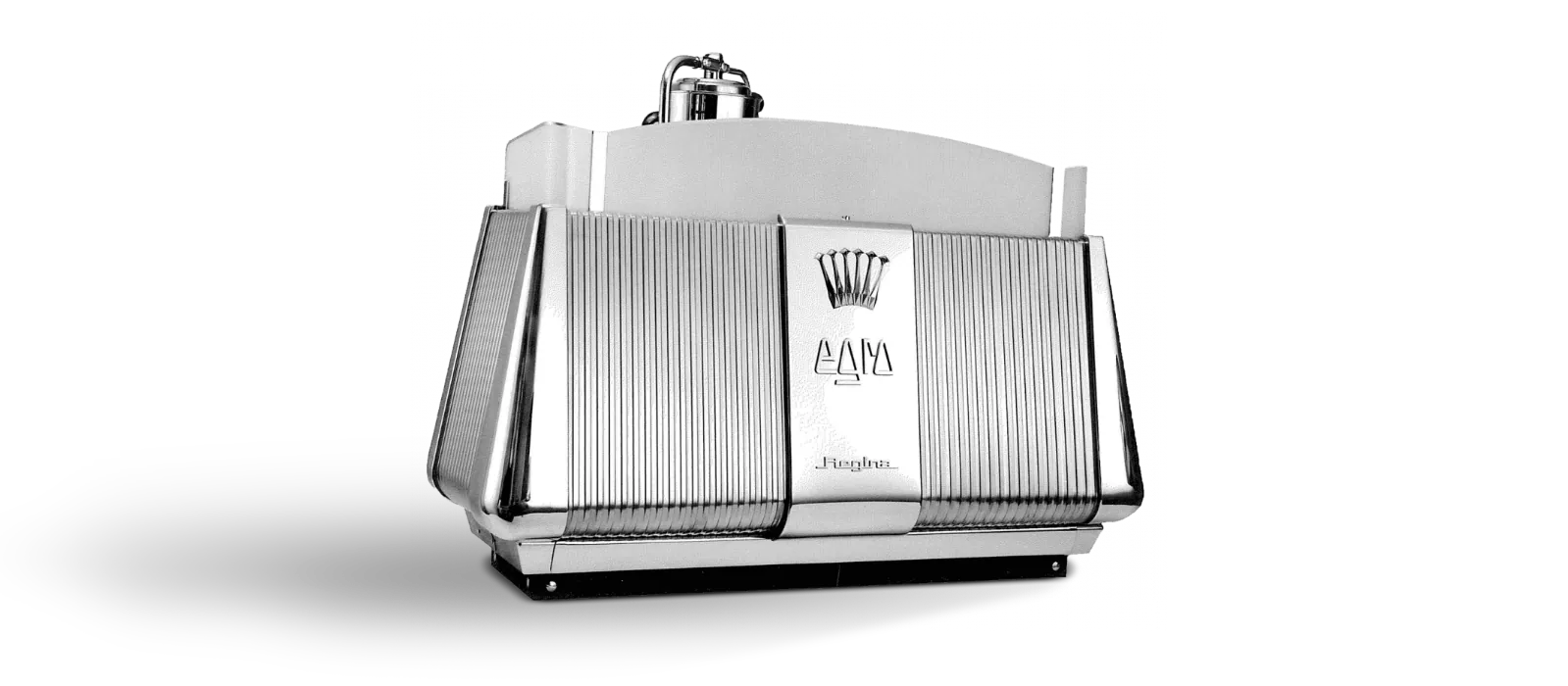
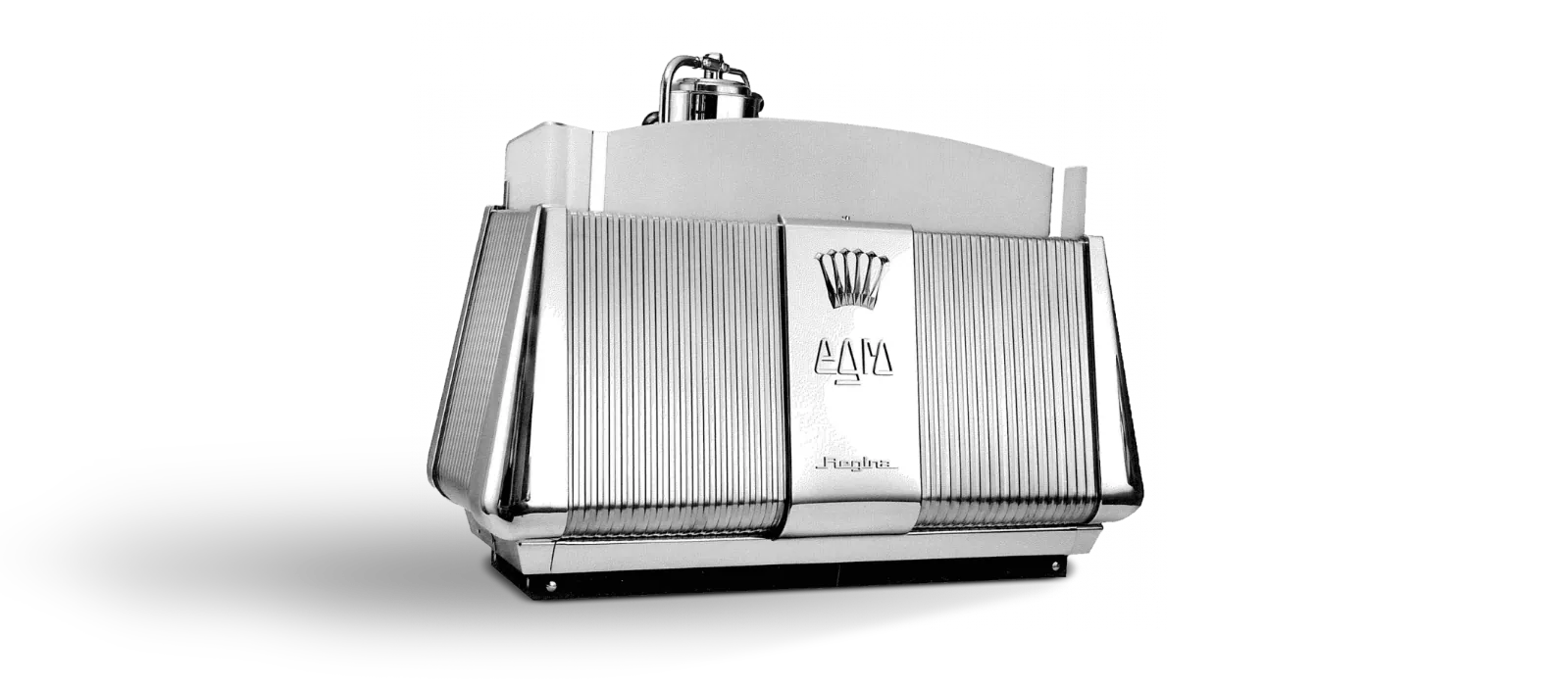
The Regina is released. The name of this new fully automatic coffee machine harks back to Roberto Rancilio's very first coffee machine.
Turnover for the coffee machine segment of the business reaches 1.3 million Swiss francs. Exports to the Netherlands, Denmark, Finland, and Austria begin.
Production of Reginetta begins. It is available in different versions, either lever or automatic and with one or two groupheads.
The coffee machine sector grows, representing 17% of the company's annual turnover. The Domino model makes its debut. Different versions of it would be produced until 1994, marking a milestone in the history of the Swiss company.
After the death of Hans Merker-Stamm, Robert Wuffi becomes the new CEO.
The Micado - the first completely automatic coffee machine - and the Colibrì enter production.
The Marabu model is introduced for quick breakfast buffet service. Its most advanced version could dispense up to 35 litres of filter coffee per hour.
The name of the company changes from Egloff & Co. to Egro AG. The name is composed of the initials EG (Egloff) and RO (Rohrdorf) and was already being used as the commercial brand on some products. Coffee machine number 1000 is delivered. New export markets for Egro - Japan and Hong Kong - are added to their established European markets, which include Germany and the Netherlands.
Egro Coffee System AG publicly launches the self-service version of the Micado model.
The AMC enters production as the first fully automatic Egro coffee machine with electronic controls, along with the BMC.
Uli Burger takes over from Robert Wuffli as the head of the company.
The Compact, the smallest fully automatic coffee machine in the world is introduced.
Egro presents the Vitesse, which would make history as the Serie 90, and patents an innovative system for grinding, brewing and dispensing.
The Comtesse CT model is introduced.
Egro patents the double brewing chamber system. The Arco model, known as the Serie 70, is introduced.
Egro creates the first version of its Serie 50 fully automatic coffee machine, initially designed as the Spirit.
Egro inaugurates its German branch in Weikersheim, near Stuttgart.
A representative office opens in Hong Kong.
Egro patents a milk system with automated cleaning actions.
Rancilio S.p.A. acquires a qualified shareholding equal to 25% of Egro Coffee System AG.
Rancilio S.p.A. becomes the majority shareholder of Egro Coffee System AG.
The Egro One, designed by Marco Bonetto, is the first fully automatic coffee machine to come out of the new collaboration between the Egro and Rancilio R&D departments.
The Egro One is awarded the bronze medal at the Excellence in Design Awards.
The acquisition process for Egro Coffee System AG is completed and Rancilio acquires full control of the company. The new Egro Suisse Headquarter with Egro LAB opens in Dottikon, Switzerland.
The Zero, a fully automatic coffee machine designed by Marco Bonetto, enters production. Egro's new milk system (NMS) is released.
The new fully automatic coffee machine BYO (Bring Your Own) is introduced, allowing users to control the machine remotely via a tablet or smartphone.
The Next is released. It is the first fully automatic coffee machine with a touchscreen interface based on the Android system, developed in collaboration with mmdesign. The Egro Zero+, an evolved version of the model launched in 2013, is introduced the same year.
The Egro Service Competence Centre is inaugurated in Dottikon (Switzerland branch). The goal of this new department of the Egro LAB is to develop and maintain technical materials and provide internal technical training for Egro products.
The Next Touch Coffee, the first fully automatic coffee machine designed for drip coffee, is released on the market. The new milk system (NMS+) developed for Egro Next enters production.
Egro Next Touch Coffee is selected by iF International Forum of Design as best product design of the year for iF Design Award.